BT151 SCR Description
The BT151 is a planar passivated silicon-controlled rectifier (SCR), also known as a thyristor. Provided in the SOT78 plastic package, the BT151 SCR comprises 4 altering N-layers and P-type (P-N-P-N) materials. It's primarily used in electrical/electronic devices where high power, high voltage switching is needed.
Once the BT151 is triggered into conduction, it remains in the "ON" state without any gate voltage until the anode-cathode current falls to a minimum value (called the holding current).
BT151 Transistor Pinout

Pin-1: Cathode, current supply output
Pin-2: Anode, current supply input
Pin-3: Conduction control between Pin-1 (Cathode) and Pin-2 (Anode)
Pin-4: Tab, connected to Pin-2 (Anode)
SCR Electronic Symbol

Depending on the biasing applied onto it, an SCR works in three different modes: forward blocking, forward conduction, and reverse blocking modes, similar to a typical bipolar transistor, and yet it has a better "latch" ability.
SCR allows the current to flow in a single direction only. So for use with AC applications, you would require 2 SCRs anti-paralleled connected in circuit to control the full AC cycle's positive and negative.
BT151 Benefits and Features
High surge current ability
Excellent thermal cycling performance
Outstanding reliability
High bidirectional blocking voltage capability
12a maximum RMS current
20mA maximum holding current
40mA latching current
15mA maximum gate trigger current
120A pulsed DC
650V Maximum off-state voltage
Where to Use BT151 Transistor
The BT151 thyristor is typically used in ignition circuits, protection circuits, industrial and domestic lighting appliances, motor controllers, static switching, various solid-state relay for over-voltage protection, full-wave bridge rectification, half-wave rectify purposes, and more.
BT151 SCR Application Circuit
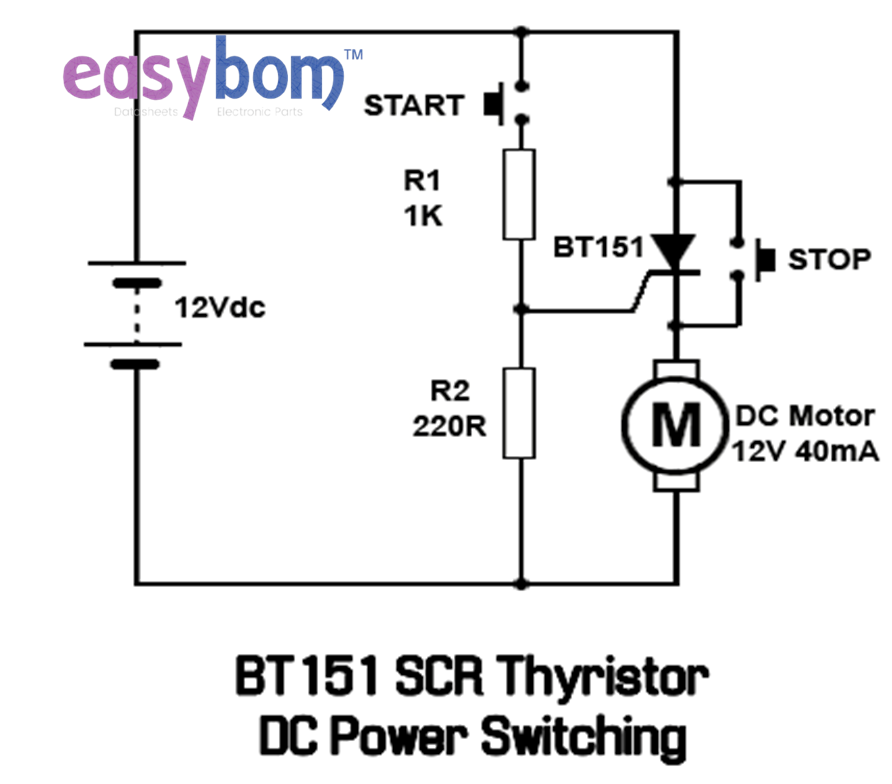
The figure above depicts a simple example of a thyristor controlling a DC load, such as a small DC motor. The motor, in this case, is connected to a 12V DC supply via the BT151 thyristor, but it will not operate until the thyristor is made to conduct. This is accomplished by briefly closing the 'start' switch, which sends a current pulse to the thyristor's gate terminal. The motor is now running as the thyristor is turned on, and its resistance is very low.
When the start switch is returned to its normally open position, there is no longer any gate current, but the thyristor continues to conduct, the current continues to flow. The motor continues to run in a DC circuit. Any subsequent operations on the start switch have no effect. The thyristor will only turn off if the current flow falls below the thyristor's holding current threshold.
This is accomplished by briefly closing the 'stop' switch, which shorts the thyristor. As the SCR current is now less than the current holding value, the circuit current now flows through the stop switch rather than the thyristor, which instantly turns off. The motor could also be stopped by connecting a normally closed switch with the thyristor. When pressed, it would also temporarily prevent current flow through the thyristor, allowing the thyristor to turn off.
BT151 SCR Testing with a Multimeter
Because the maximum gate-trigger voltage (VGT) is 1.5V so a common multimeter would do the test job neatly, follow these procedures to tell if your SCR is bad.

Turn on the multimeter and switch it to the 'diode' mode
Refer to the BT151 datasheet to verify the pin connection of the SCR
Attach the black (negative) terminal with the Cathode pin and the red (positive) with the Anode pin
The multimeter reads nothing because the SCR is not turned on
If the multimeter stays on certain value all the time, the SCR is shorted
Hook a load, a resistor, and the BT151 in series
Trigger the Gate by making it touch with the Anode or applying a positive voltage to the Gate pin
Repeat step-3
If the meter's reading rises (which is the forward voltage of the SCR) and stays on ("latch-on" feature of the SCR), the SCR is good
Equivalents for BT151 Replacement
BT152, 2N6508, TYN208, BT150
Download BT151-500R Datasheets


 Marshall ·