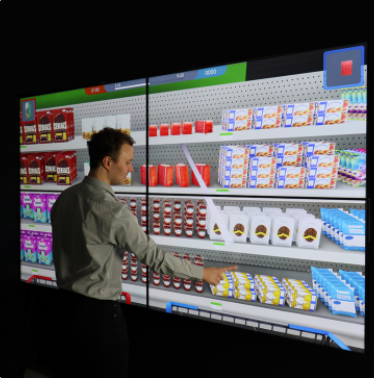
Touch technology innovator Zytronic has launched ZyBrid edge touch sensor technology, which aims to create amazing multi-screen interactive video walls and tables.
The glass sensor is designed to mirror the narrowest frame of the video wall display, with a narrow frame (from 3 mm to zero), creating a stylish appearance by using the largest display area. When used with the associated ZyBrid edge controller, sensors can be creatively connected to achieve a seamless touch transition between screens and there may be no gap between adjacent active areas.
Usually, AV installers install a huge piece of protective glass on the entire interactive video wall. Then, they often use clip infrared or camera-based touch detection systems on the outside of the tiled screen. This arrangement creates a large, ugly, protruding border on the edge of the wall, even if interactivity is needed only on some monitors. This also means that if the monitor needs to be adjusted or replaced, the entire glass cover (which may be 3 x 3m or greater) must be removed from the touch detection frame. In addition, these touch detection techniques are often vulnerable to errors and unexpected touches.
They can also be confused by intense direct sunlight. To make matters worse, if dust and debris accumulate on the surface, the efficiency of the light transmitter or receiver may be affected, stopping the interactive video wall altogether. Current alternative technologies, such as traditional projective capacitive or acoustically based touch systems, have wider boundaries, which undermines the very tight tiled and beautiful appearance that interactive video walls should have.
"the new Zytronic projected capacitor solution eliminates these two problems, enables ultra-fast and accurate touchscreen response, and provides borders to match the latest near borderless LCD," said Ian Crosby, director of sales and marketing at Zytronic.
Each narrow-frame ZyBrid edge sensor is supported by a dedicated ZYX500-based multi-touch controller connected by a set of RJ45 data lines. Then, the connected associated controller is finally connected to a single leading master controller. The controller is equipped with a manual toggle switch to change the on-board firmware settings, allowing AV installers to quickly choose whether to set it as an associated controller or a primary controller. Only one type of controller is needed to reduce system complexity and component inventory.
In an innovative development, Zytronic also designed proprietary firmware for special ZXY500 controllers. The firmware allows the master controller to "splice" data from each associated controller, and then the master controller provides a set of xy coordinates to the host as a USB HID "plug and play" touch screen device. "the computer only 'sees' a huge touch sensor, not a separate touch screen," Crosby explained.
This novel method solves the problem of loss of touch coordinates when a user passes a finger from a screen to an adjacent unit to achieve a "handshake" between seamless coordinates and touch contact ID transmission-no matter how many people interact with the video wall. A single touch sensor can be connected to the bottom layer narrow frame display using a properly designed frame or optical bonding. When tiled next to it, the touch controllers of each screen are linked together to create a huge, almost borderless interactive wall.
Another benefit of this separate but chainable and tiling method is that only individual displays that are accessible to the user's fingertips need to be equipped with a ZyBrid edge touch sensor. Senior staff only need to install protective glass which can significantly save costs and significantly simplify maintenance work.
Like all Zytronic touch sensors, the size and design can be completely customized. In terms of size, the main requirements are expected to be 37, 46, 49, 55, and 65 inches, matching the narrow-frame video wall displays most commonly used by vendors such as Christie, LG, NEC, Philips, and Samsung. Glass touch sensors can be made of 3, 4 and 6 mm thermally toughened glass with normal or anti-glare finishes, depending on customer requirements and impact requirements.
"With Zytronic's latest development, AV system installers can create accurate and responsive projection capacitive touch screen video walls of almost any size," Concluded Crosby. "The Zytronic video Wall solution is almost infinitely scalable, giving them endless possibilities to create the ultimate interactive experience from mission control rooms, corporate headquarters and museums to flagship department stores."


 Candice ·