

555 Timer Calculator
View Details

Battery Life Calculator
View Details

Bridged-Tee Attenuator Calculator
View Details

Capacitor Safety Discharge Calculator
View Details


Capacitors and inductors are passive components widely used in electrical or electronic circuits. A capacitive or inductive reactance calculator is an online tool used to measure the resistance of the capacitor and inductor. Alternating current can also pass through the coil, but the inductance of the coil has an obstructive effect on the alternating current. This obstruction is called inductive reactance. The more difficult it is for alternating current to pass through the coil, the greater the inductance, the greater the obstructive effect of the inductance; the higher the frequency of the alternating current, the more difficult it is to pass through the coil, and the obstructive effect of inductance is also greater. Experiments have proved that inductance is proportional to inductance and also proportional to frequency. If the inductance is represented by XL, the inductance is represented by L, and the frequency is represented by f, then the calculation formula is: XL = 2πfL = ωL The greater the capacitance of the capacitor is, the greater the capacity of the capacitor to store charges is. Under the condition of a certain voltage, the greater the amount of charge and discharge moving in the circuit per unit time, the greater the current, so the capacitance hinders the alternating current The smaller the capacitance, the smaller the capacitive reactance; when the voltage of the alternating current is constant, the higher the frequency of the alternating current, the more frequent the charge and discharge in the circuit, the greater the charge movement rate per unit time, the greater the current, and the capacitance is opposite to each other. The smaller the hindering effect of the variable current is, the smaller the capacitive reactance. The calculation formula is: Xc = 1 / (2πfC)


Alternating current can pass through the capacitor, but when the capacitor is connected to the AC circuit, the charge on the plate of the capacitor has an obstructive effect on the directional moving charge. In physics, this obstructive effect is called capacitive reactance, which is represented by the letter Xc.
When current flows through the coil, an induced electromagnetic field will be formed in the coil and the induced electromagnetic field will generate an induced current in the coil to resist the current passing through the coil. Therefore, we call the interaction between this current and the coil the inductive reactance, which is the inductance in the circuit.
In a circuit with resistance, inductance, and capacitance, the hindrance to the current in the circuit is called impedance. The unit of impedance is ohm.
One of the important characteristics of AC is its frequency f. We can use the following formula to calculate the capacitive reactance X of capacitor C: Xc = 1 / (2πfC). Or, we can write the capacitive reactance formula as: X = 1 / (ω C), Where ω = 2πf is the angular frequency of the current.
XL= 2πfL = ωL, where ω = 2πf is the angular frequency of the current.
Z= R+j (ωL–1/ (ωC)) Explanation: The load is a complex of three types: resistance, inductive reactance of inductance, and capacitive reactance of capacitors. They are collectively referred to as "impedance" after being combined. The mathematical formula is: Impedance Z= R+j (ωL–1/ (ωC)). Among them, R is the resistance, ωL is the inductive reactance, and 1 / (ωC) is the capacitive reactance.
Impedance voltage is also called short-circuit voltage, which represents the voltage loss (percentage) generated on the transformer's own impedance when the transformer passes the rated current.
Resistance is always positive, and reactance can be positive or negative. The resistance in the circuit dissipates power in the form of heat, while the reactance stores energy in the form of electric or magnetic fields.
Higher impedance allows the use of more turns in the voice coil of the driver, which can improve the sound of the headset.
Resistance and reactance are characteristics of circuits that are opposite to current. The main difference between resistance and reactance is that resistance measures the resistance to current flow, while reactance measures the resistance to current changes.
At the physical level, many things are simplified: resistance is caused by electrons colliding with atoms inside the resistor. The impedance in a capacitor is caused by the generation of an electric field. The impedance in an inductor is caused by the generation of a magnetic field.
The main reason for the ground loop impedance test (usually referred to as the loop test) is to verify whether there is enough current to run within a predetermined time to protect the fuse or circuit breaker of the faulty circuit if an electrical device fails.
There are two types of reactance: capacitive reactance (XC) and inductive reactance (XL).
There are several inductive components in a loop, and the loop itself also has inductive effects such as inductance or capacitance. In engineering calculations, the above-mentioned inductances are either connected in parallel or in series, and finally all merged into an inductive reactance to facilitate calculation. This combined circuit inductance is equivalent to several inductances in the original circuit, which is equivalent inductance.
The size of inductive reactance is determined by the frequency f of the alternating current and the inductance L of the coil.
As long as there is a current passing through a section of wire, a magnetic field will be established around the wire (right-handed spiral law), and the transmission line and the earth form a closed loop. Any change in the magnetic field lines in this closed loop will cause an induced electromotive force on the transmission line. This is the inductance, and this kind of inductance is called distributed inductance, but this kind of distributed inductance is very small in terms of volume-inductance ratio compared to inductance elements wound into a coil with an iron core, and can be ignored in many cases.
Yes, as long as there is current flowing there will be inductive reactance. A straight wire can also be understood as a closed loop at infinity.
The capacitance is large, and the alternating current is easy to pass through the capacitance, indicating that the capacitance is large, and the obstructive effect of the capacitor is small; the frequency of alternating current is high, and the alternating current is easy to pass through the capacitor, indicating that the frequency is high, and the obstructive effect of the capacitor is also small. Experiments have shown that capacitive reactance is inversely proportional to capacitance and also inversely proportional to frequency. If capacitive reactance is represented by Xc, capacitance is represented by C, and frequency is represented by f, then Xc=1 / (2πfC). The unit of capacitive reactance is ohms. Knowing the frequency f and capacitance C of the alternating current, the capacitive reactance can be calculated using the above formula. For DC capacitors, it is equivalent to an open circuit, so the capacitive reactance is infinite.
1) The greater the self-inductance of the inductor, the greater the inductive reactance. 2) Current, the higher the frequency of the AC inductor, the greater the inductance of the inductor.
In a pure capacitive circuit, the current leads the voltage by 90º; In a purely inductive circuit, the current lags the voltage by 90º; The capacitive reactance decreases with the increase of the current frequency, and the inductive reactance increases with the increase of the current frequency; After connecting the capacitor and the inductor in series, when the current makes the capacitive reactance equal to the inductive reactance at a certain frequency, the lagging current of the inductance in the circuit and the leading current of the capacitor can be complementary to the same phase of the current and voltage. That is, the inductive reactance and capacitive reactance in the circuit "disappear", and we call it the "resonant state" at this time.

 MarshallNovember 20,2024719
Flexible manufacturing enables small batch customization, reducing risks and enhancing market responsiveness in dynamic industries.

 AshleyAugust 22,20242887
As global technology continues to advance, the electronic components market in 2024 exhibits a series of new trends and challenges.
 CandiceAugust 07,20241114
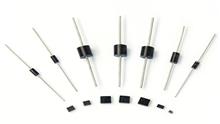
A Transient Voltage Suppressor (TVS) is a semiconductor device structured to secure electronic circuits from transient spikes in voltage. When a transient voltage surpasses the TVS’s specific clamping voltage, the TVS becomes conductive, detaching the excessive energy away from the susceptible components to protect.